Showing posts with label social enterprise square mile. Show all posts

Thursday, 3 May 2012

Boris or Ken: which of London's Leviathans should social enterprise choose?

On the eve of the election, Allison Ogden-Newton takes a look at what the leading candidates in the mayoral race can offer social enterprise
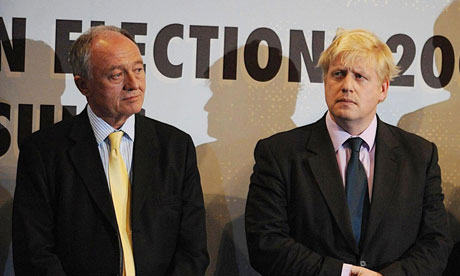
London Mayoral election

Boris Johnson or Ken Livingstone: which candidate can do more for social enterprise? Photograph: John Stillwell/PA Wire

Update: Posted 10th May from the London Communications Agency :

"The result finally came through at just after midnight with the figures showing a victory by just 3% for Boris over Ken after second preference votes. Green candidate Jenny Jones won third place from Lib Dem Brian Paddick whilst independent Siobhan Benita took a respectable fifth place. Turnout came in at 37.9%, five percent more than the local election results.- I don't know how many of those 37.9% were social entrepreneurs but my guess is more than you would expect.

Today, we go to the polls to decide who should lead us locally. Times are tough, the issues have never affected the electorate as they do now. We have rising unemployment, local authority cuts, reduced services, changes in disability allowances, increased transport costs and yet the pundits are saying turnout will be low. Will that be the case in London, where two of the biggest personalities in UK politics slug it out one more time? Or will the Boris versus Ken show inspire Londoners to hit the polling stations and get their views heard?

In any event, I have been trying to work out what our very own Romulus and Remus think about social enterprise in a campaign so overshadowed by personality that the issues have struggled to get a look in. Social enterprise matters to me, and it matters to London's large and growing ethical business community, so where is it reflected in the candidates' campaigns? Social Enterprise London (SEL) published a manifesto which Boris signed up to saying he "is extremely supportive of the aspirations behind your manifesto and believes that you will find many of your key asks reflected in the 'Growing the London economy' chapter of his manifesto."

On closer inspection, we think this means that Boris is going with our idea of a social enterprise square mile as part of 2012 Legacy, and also the work we do enabling public sector workers to set up as independent service providers.

Ken's campaign has been based on support for the co-operative side of the social enterprise world. Ken attended the launch of the co-operative manifesto and much of his campaign trail language about mutualism and community benefit comes straight from that tradition. When Ken was mayor, he came to SEL conferences and has also committed his support in the past to the role of social enterprises in the delivery of the games, though the London Development Agency, when it still existed, always struggled under both mayors to know where to put social enterprise, so was inclined not to put it anywhere at all, unless you count communications.
Since becoming mayor, Boris has been much more unequivocal in his support for social enterprise but similarly struggled to find the right connection in City Hall to result in material benefit for the community.

So we have Boris, who recently said, "Social enterprise helps people reach their full potential by providing training and employment opportunities," and then Ken, who has said, "I want to make sure London is a success and I have no doubt that increasing the number of businesses that trade with a social purpose will help this vision."

As both of them have had a go at the job over the last 12 years, when social enterprise has made great strides, could either mayor have done more? What exactly can either one of them do for social enterprises in London now? Will they be able to or inclined to restore business support for the largest social enterprise community in the UK? Will they have infrastructure of their own to provide a platform to promote our social enterprise community both at home and abroad? Or will they hope that, in the event of electoral success, somehow this eclectic, multi-cultural, ethical business engine will continue to create opportunity for the poorest Londoners without their assistance? Let's hope not, especially if they want our votes today.

How are you going to vote and why? Share your views in the comments section below.

Allison Ogden-Newton is chief executive of Social Enterprise London.

This content is brought to you by Guardian Professional. To join the social enterprise network, click here.

Tuesday, 10 January 2012


Can 2012 deliver the world's first social enterprise square mile?

New Olympic contract wins could start a trend, says SEL's Allison Ogden-Newton
Olympics 2004 Athens Feature
The London Olympics could be good for social enterprises. Olympia/ Photograph: Arne Dedert/EPA
2012 starts with a bang as news breaks that social enterprise, Leisure Trust GLL, has won the landmark contract to manage the London Aquatics Centre and the Multi Use Centre (Handball Arena), whilst the development agency Renaisi, in partnership with Balfour Beatty and charity Groundwork, gets the contract to run the Olympic Park. These bids will deliver jobs and community regeneration and much more through entrepreneurialism that understands the importance of enhancing social value. There is a vision at work here and it is to make good on the promises of the legacy by supporting the most audacious community development any games has ever undertaken through the canny management of the site's assets.
That might sound like hype, but a closer look at the successful tenders show some very clever, ethically-driven plans to create jobs; giving local people a real stake in the facilities the games leave behind.
I spoke to Rob Pearce, Director at Renaisi, who told me that "We argued strongly that you will only get a great park if you create and involve successful neighbors and unless you create a specific mechanism, like a social enterprise, with that purpose in mind a park that inspires would be hard to achieve."
The community interest company "Our Parklife" that got the green light from the Olympic Park Legacy Company brings together co-curators Balfour Beatty, Renaisi and Groundwork. It will guarantee that jobs are created for local people and will ensure that a minimum of 50% of the supply chain contracts go to local small and medium-sized enterprises. It sets a clear vision for local integration and, like the GLL bid, creates a framework for a sustainable park where local communities will see real benefits.
GLL is another success story, and this latest landmark contract will mean a great deal to others in the social enterprise world given their strong social enterprise supply chain. Mark Sesnan, GLL's managing director told me they will "make a real difference", by working with other social enterprises. For example, GLL plan to work closely with transport specialists Hackney Community Transport (HCT), as well as London Recycling Network who have developed innovative recycling in East London and local social housing agencies. This will ensure that GLL's success supports other community based partners for a socially sustainable future.
HCT has been providing transport on the Olympic site for the last four years and its managing director Dai Powell told me he was delighted with today's news, adding: "When you look at the confidence public bodies and the public themselves are showing in social enterprises you realise that now is our time."
These latest contracts and other proposals, such as Business In The Communities plans to turn the 2012 Olympics Media Centre into a social enterprise business hub, all add up to the possibility of the world's first social enterprise square mile, set in London's Olympic park, post 2012.
I am sure the OPLC wants to make sure we don't get a games like Atlanta in 1996, where jobs failed to materialize, or Sydney in 2000 where the Olympic Park, set 18 miles outside the city, couldn't inspire a community to grow up around it and remains isolated and in a state of decline. Or, worse yet, Athens: where a failure to plan for any legacy missed every trick in the book with many of the facilities mothballed and jobs nowhere to be found.
It is fortunate that the 2012 games are set in the city that is acknowledged worldwide as the lead for social enterprise development. By choosing to back social enterprises based in London which innovate in regeneration, environmentalism and social impact, the OPLC has invested in a vision where a great games is just the starting gun ahead of the main event: a sustainable community where everyone is a winner.
Allison Ogden-Newton is chief executive of Social Enterprise London.